
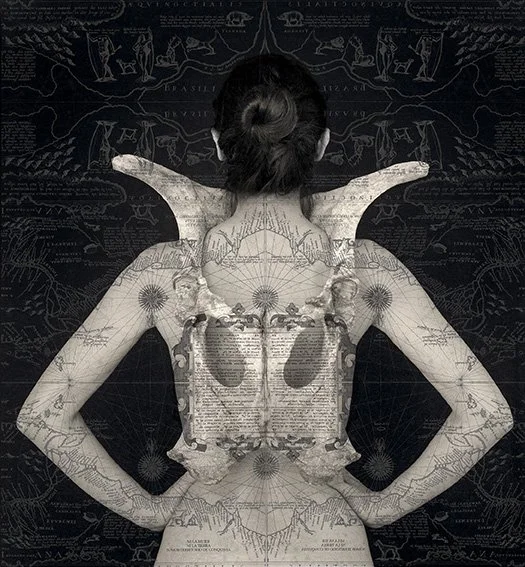
Tatiana Parcero in JSMA Exhibition
Mapping Familiar Territories, Charting New Paths
Mapping Familiar Territories, Charting New Paths is being presented at the Jordan Schnitzer Museum of Art at Portland State University. This exhibition brings together artists who reinterpret and expand mapping practices to explore questions of place, identity, and power. Through diverse media and distinct approaches, the exhibiting artists use the language of cartography to uncover personal histories, unearth collective narratives, and address pressing social and environmental concerns.
The exhibition includes work by eleven artists and was curated by Alexandra Terry, Head of Curatorial Affairs & Curator of Contemporary Art at the New Mexico Museum of Art.
The lead-image for the museum Exhibition is Ossis #20 by Tatiana Parcero. This artwork is layered and powerful. It features the artist’s body- her head, shoulders and torso to the sacrum from the back. She wears a cow bone- a pelvis- as a shield of armor. She faces away from us against a black ground. An antique map that features Brazil and elements of it are mirrored across the center of the image, along the artist’s own backbone. Polar culottes that usually appear at the poles of globes decorate the body at what feel like spaces of sacred connection. A shoreline with place names become abstracted aspect of design. Much of the text in general is reversed to us, as if we were standing behind an invisible screen being read from the other side. Animals and hunters decorate the margins. A Diana-type figure is shown in confidence, holding a bow larger than she is tall while the male figure is shown as a “walking man” without a head.
Scrolls of text are at the center of the image at the core of the figure’s back and heart of her shield of bone. These are a difficult read, part in Latin and part in Spanish. They feel like a declaration and recall a declarative and decorative text element of colonial period maps which emphasized dominion, visibility, and wealth. This contains some phrasing original to a source-map and some wording written and inserted by the artist.
“A new geographical map, displaying and presenting before the eyes of all a most faithful depiction of the most powerful and gold-bearing [land]. Neither woman, neither land are territory to be conquered.” The latter part of this phrasing is the artist’s. It is repeated clearly across the base of the image.
Ni la mujer ni la tierra somos territoria de conquesta : Neither woman neither land are territory to be conquered. This phrasing, its position, and context work as both a proclamation of victory and a rallying cry for defense.
Stay tuned for details on related programming:
Artist’s talk at JSMA|PSU Thursday, April 23
